

Saudi Arabia is the Gulf’s biggest e-commerce prize. The market is worth an estimated $31.29 billion in 2026 and is projected to reach $54.87 billion by 2031. Shoppers here are mobile-first, mada and Apple Pay are second nature, and the government has digitised almost every step of starting a business.
The problem? Most English-language information is written by company-formation firms selling expensive packages, not by people explaining it for sellers. This guide fixes that. Whether you are a Saudi resident, an expat on an Iqama, or a foreign founder looking at the Kingdom, here is the full path to starting an ecommerce business in Saudi Arabia, from idea to first order.
Step 1: Decide What You Will Sell (and How)
Your business model decides your legal setup, your platform and your costs, so settle it first:
- Your own store (DTC): You sell through your own website (Salla, Zid, Shopify). Highest margin and you own the customer data — this guide focuses on this model.
- Marketplaces: Noon and Amazon.sa bring traffic but charge commissions and control the customer relationship.
- Social selling: Instagram and TikTok drive discovery in Saudi; many sellers start with social traffic into their own store.
Pick a niche where you have an edge: product knowledge, a sourcing route (for example 1688/Alibaba for importing), or an audience. Saudi demand is strong in fashion, beauty, perfume/oud, electronics accessories, and home goods — but competition follows demand, so specialise.
Step 2: Get Legal — Commercial Registration (CR) or MISA Licence
Selling online commercially in Saudi Arabia requires a legal entity. There are three common routes:
- Commercial Registration (CR) — for Saudi nationals and GCC citizens, and for companies. A CR from the Ministry of Commerce is the standard business licence. It records your business activity (add the e-commerce activity), and it is what banks, payment gateways and platforms ask for.
- MISA licence — for foreign investors and most expats. If you are a foreigner without a Saudi-owned company, foreign investment licensing runs through MISA (Ministry of Investment). MISA licensing allows 100% foreign ownership in many activities, including trading/e-commerce structures, after which you obtain the CR. This is the route most expat founders take.
- Freelance Work Permit — for eligible residents. Saudi residents (including some expat categories) can obtain a freelance document for approved activities, which some solo sellers use to start lean. Check that your activity is on the approved list before relying on it.
Whichever route you take, you will also need:
- A National Address (from Saudi Post / SPL) for the business — required across government services.
- A business bank account once your CR is issued.
- Registration with ZATCA for VAT if your taxable supplies exceed the mandatory threshold of SAR 375,000 per year (voluntary registration starts at SAR 187,500).
Costs vary by route and activity — treat any single “package price” quoted by formation agents with caution, and verify current fees on the official Ministry of Commerce / MISA / Saudi Business Center channels before paying anyone.

Step 3: Choose Your Store Platform
Four platforms cover almost every Saudi seller (see our Salla vs Zid vs Shopify vs WooCommerce comparison):
| Platform | Best for | Starting price (2026) |
|---|---|---|
| Salla | Arabic-first Saudi sellers, local integrations built in | Free tier; paid from ~SAR 99/mo |
| Zid | Saudi platform with strong local shipping/payment links | Free tier; paid from ~SAR 99/mo |
| Shopify | Global apps, themes and multi-market selling | From ~$39/mo |
| WooCommerce | Full control on your own hosting | Free plugin + hosting |
Salla and Zid are built for Saudi: mada, Apple Pay, Tamara/Tabby and local couriers connect in a few clicks, and both issue ZATCA-compliant invoices on paid plans. Shopify works in Saudi Arabia too — you can register, set SAR pricing and sell — but some payment and invoicing pieces need extra setup.
Step 4: Set Up Payments — mada Is Not Optional
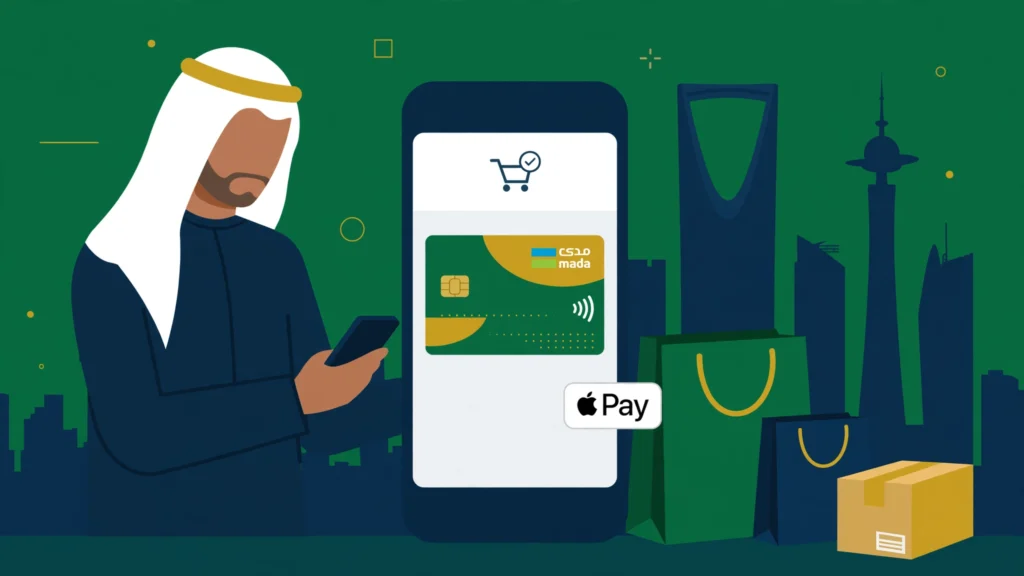
Saudi shoppers pay with mada (the local debit scheme), Apple Pay, credit cards, and buy-now-pay-later services like Tabby and Tamara. Cash on delivery still matters in some categories, but prepaid digital payment is the default expectation in 2026 — a store without mada and Apple Pay will leak conversions.
You do not connect to mada directly. You sign up with a payment gateway such as Moyasar, PayTabs, HyperPay, or Tap Payments, which bundles mada + cards + Apple Pay into one integration. Gateways require your CR (or MISA licence + CR), business bank account and National Address — another reason Step 2 comes first. Fees are typically a percentage per transaction plus a small fixed amount.
Step 5: Shipping and the National Address
Delivery expectations in Saudi are high: fast, tracked, and with easy returns. Your main options:
- Local couriers: SMSA, Aramex, DHL and SPL (Saudi Post) cover the Kingdom; aggregators like Oto connect multiple couriers to Salla/Zid/Shopify in one dashboard.
- Platform fulfilment: If you later sell on Noon or Amazon.sa, their fulfilment programs (FBN/FBA) handle storage and delivery for a fee.
Your business National Address doubles as your official address for licences and returns — register it early because banks, gateways and some couriers ask for it.
Step 6: VAT and ZATCA E-Invoicing
Two tax duties matter from day one:
- VAT registration once you pass SAR 375,000 in taxable supplies (15% VAT rate). Below that, registration is optional but some B2B sellers register voluntarily.
- ZATCA e-invoicing (Fatoorah): Phase 2 requires in-scope businesses to generate structured electronic invoices integrated with ZATCA, rolled out in waves by revenue size. Wave 25 covers businesses with VAT-taxable revenue above SAR 187,500 (in 2022 or 2023), with integration required by 1 February 2027. Salla, Zid and most accounting tools now generate compliant e-invoices — confirm your plan tier includes Phase 2 integration, not just invoice PDFs.
Step 7: Verify Your Store and Build Trust
Saudi buyers check trust signals before paying a new store. Cover the basics:
- Display your CR number and VAT number (if registered) in your footer, along with clear contact details and a returns policy.
- Verify your business through the Saudi Business Center channels where applicable to your licence type.
- Show real delivery times, a working Saudi contact channel (WhatsApp is standard), and Arabic product names alongside English where your audience needs it.
Launch Checklist
- Business model and niche chosen
- CR issued (or MISA licence + CR) with e-commerce activity
- National Address registered
- Business bank account opened
- Platform chosen and store built (Arabic + English)
- Payment gateway approved — mada, Apple Pay, cards live
- BNPL (Tabby/Tamara) applied for if your category suits it
- Courier or aggregator connected, shipping zones and rates set
- VAT position confirmed; e-invoicing working on your plan
- CR/VAT details, returns policy and contact info in the footer
- Test order placed end-to-end (payment → invoice → shipping label)
- Analytics (GA4) and Search Console connected
How Much Does It Cost to Start?
Budget ranges for a lean launch in 2026 (your legal route is the biggest variable):
- Licence route: CR-only setups are the cheapest; MISA-route foreign-owned setups cost more and usually involve service fees — get itemised quotes.
- Platform: SAR 0–99/mo to start on Salla/Zid; ~$39/mo on Shopify.
- Payments: no large upfront cost typically; per-transaction fees apply.
- Domain + basics: a .com and business email run to a few hundred SAR per year.
- Stock/marketing: entirely your choice — many sellers validate with a small test budget before scaling ads.
FAQs
Can a foreigner start an online business in Saudi Arabia?
Yes. Foreign founders typically use the MISA investment licence route (which can allow 100% foreign ownership for approved activities) and then obtain a CR. Residents should check whether their Iqama profession and sponsor situation allow business activity, or whether a freelance document covers their case.
Do I need a CR to sell on Salla or Zid?
To unlock payment gateways and operate as a business, yes — gateways require a CR (and bank account). You can build and explore a store before that, but you cannot properly take mada payments without the legal setup.
Can I use Shopify in Saudi Arabia?
Yes. Shopify supports Saudi sellers and SAR pricing. The extra work is in payments (you will plug in a local gateway for mada) and ZATCA e-invoicing — both solvable with the right setup.
Is cash on delivery still important in Saudi Arabia?
Less than it was. Prepaid methods (mada, Apple Pay, cards, BNPL) dominate online checkout behaviour in major categories, but COD can still lift conversion for first-time buyers in some niches — test it rather than assuming.
When do I register for VAT?
Mandatory at SAR 375,000 in taxable supplies over 12 months; voluntary from SAR 187,500. Separately, ZATCA e-invoicing Phase 2 waves are based on revenue thresholds — Wave 25 (above SAR 187,500) must integrate by 1 February 2027.
Next Steps
Start with your legal route (Step 2) — everything else waits on it. Then pick your platform, build your stack, and work the launch checklist top to bottom.
Saudi Seller Hub publishes plain-English guides for sellers entering Saudi e-commerce. Rules and fees change — always confirm licence and tax details with the official source before acting.
2 thoughts on “How to Start an Ecommerce Business in Saudi Arabia (2026 Guide)”
Comments are closed.