

You don’t need to be Saudi to sell online in Saudi Arabia — the Kingdom actively licenses foreign investors. But the route is different from a Saudi national’s, the order of steps matters, and the internet is full of formation agents quoting five figures for what is mostly a paperwork sequence. This guide lays out the real route in plain English: MISA licence first, then Commercial Registration, then the accounts and registrations that let you actually trade.
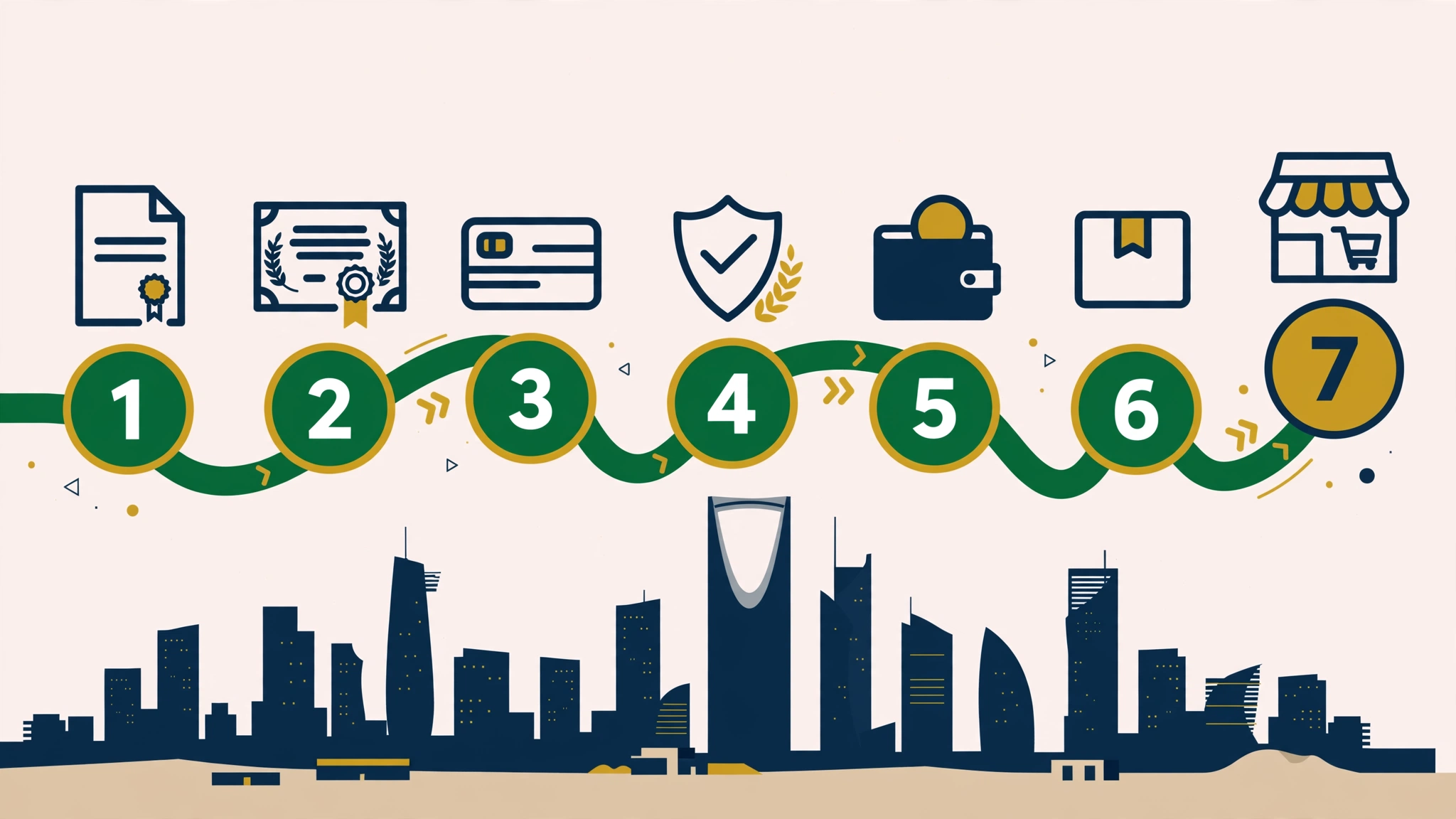
The Route at a Glance
- MISA investor licence — the Ministry of Investment licenses you as a foreign investor for a specific activity (your ecommerce/trading activity).
- Commercial Registration (CR) — issued through the Ministry of Commerce / Saudi Business Center once the MISA licence exists; this is your company’s legal trading identity.
- Chamber of Commerce membership — activated alongside the CR.
- National Address — your official business address registration (via Saudi Post, SPL).
- Business bank account — opened with CR + licence; required for payment gateways and SAR settlements.
- ZATCA registration — VAT registration when you cross the threshold, and e-invoicing per your Phase 2 wave (see our ZATCA guide).
- Government portals — Qiwa (labour), GOSI (social insurance), Muqeem — relevant once you employ anyone or hold visas through the company.
Only after steps 1–5 can you open Salla/Zid/Shopify + a payment gateway properly in the company’s name — which is why setup comes before store-building in our pillar guide’s sequence.
Step 1: The MISA Licence (The Foreigner’s Gate)
The Ministry of Investment of Saudi Arabia (MISA) issues investor licences by activity. Key points to understand before you apply:
- Licence type follows activity. Services, trading and industrial licences have different conditions. Pure trading (wholesale/retail) historically carries extra conditions for foreign ownership; many ecommerce models are structured under licences whose conditions you must confirm for your exact activity on MISA’s official channels before committing.
- 100% foreign ownership is possible for many activities — but it is activity-specific, never assume it. Check your activity code’s conditions first.
- Documents are attested. Your home-country company documents (or personal documents for individual founders) typically need chamber/embassy attestation and Arabic translation. This is the step that eats calendar time, not the Saudi-side approvals.
- Fees are official and published by MISA for each licence type — anyone quoting you a wildly different “government fee” is padding. Verify the current fee for your licence type on misa.gov.sa.

Step 2: Commercial Registration (CR)
With the MISA licence in hand, the CR is issued through the Saudi Business Center / Ministry of Commerce — increasingly a same-day digital process for standard cases. Your CR records the company name, activity, capital and manager. The CR fee itself is modest (a few hundred SAR per year plus Chamber of Commerce fees — confirm the current schedule officially); the real costs of setup are the licence, attestations, translations and any office/address solution you choose.
Step 3: The Accounts That Make You Operational
- National Address (SPL): register the business address; banks and gateways ask for it.
- Bank account: Saudi banks onboard foreign-owned companies with CR + MISA licence + National Address + the authorised manager’s ID/Iqama. Expect KYC questions about source of funds and business activity — prepare real answers and documents.
- ZATCA: register for VAT when required (mandatory above SAR 375,000 taxable turnover) and track your e-invoicing wave (our ZATCA Phase 2 guide breaks down Wave 25 and the 1 Feb 2027 deadline).
What About Iqama Holders (Expats Already in Saudi)?
If you live in Saudi on someone else’s sponsorship, your Iqama alone does not let you own a trading business — commercial activity in your own name generally requires either Saudi nationality/GCC status, a MISA investor licence (with its own visa route), or working under a structure owned by someone who is licensed. Beware two traps: tasattur (a Saudi lending their name/CR to your business for a cut) is a criminal offence with severe penalties, and “freelance permits” cover specific permitted freelance activities — they are not a back-door trading licence for a goods business. If your plan is goods ecommerce under your own control, the MISA route is the clean way.
Realistic Costs & Timeline (Orientation, Not Quotes)
- Government-side fees: MISA licence fee (by type — verify officially) + CR fee + Chamber fees: the official components are published; the total is far below typical agent quotes.
- Variable costs: document attestation in your home country, certified Arabic translations, registered address solution, and any PRO/agent you choose to hire for convenience.
- Timeline: the attestation chain usually decides it — days if your documents are ready and your activity is standard; weeks if anything needs re-issuing. Anyone promising “full setup in 48 hours” for a foreign trading company is selling you the enquiry form, not the licence.
Mistakes Foreign Founders Make
- Choosing the wrong activity code — then discovering their store model isn’t covered by their licence.
- Skipping attestation prep — starting the Saudi side before home-country documents are attested and translated.
- Using a Saudi name-lender (tasattur) — criminal liability for both sides.
- Opening the store before the entity — gateways settle to a business bank account in the CR name; a store built first creates a payments dead-end.
- Believing the first agent quote — always price the official route first (MISA + Saudi Business Center publish the steps), then decide if an agent’s convenience fee is worth it to you.
FAQs
Can a foreigner own 100% of a Saudi ecommerce company?
For many activities, yes — but ownership conditions are set per activity by MISA. Confirm your exact activity before structuring.
Do I need to live in Saudi to run it?
The investor route can lead to an investor visa/residency, and many founders operate with a local manager. Presence requirements depend on the licence and banking — confirm for your case.
Can I just sell on Noon/Amazon.sa from my home-country company instead?
Cross-border marketplace selling exists (with non-resident VAT duties, a tax representative and import rules) (cross-border marketplace selling is covered later in this series), but it is a different model from owning a Saudi store, with weaker payment options for your own site.
This guide is general information from official sources at writing, not legal advice. Licence conditions and fees change — confirm your activity’s requirements on misa.gov.sa and the Saudi Business Center before acting.
Related Guides
- How to Start an Ecommerce Business in Saudi Arabia (2026 Guide)
- ZATCA E-Invoicing Phase 2 for Online Sellers: VAT Threshold, Wave 25 & the 1 Feb 2027 Deadline
- Salla Pricing in Saudi Arabia: Plans, Fees & What You Actually Pay (2026)
- Best Payment Gateways in Saudi Arabia for Online Stores (2026)
- How to Sell on Noon Saudi Arabia: Seller Requirements, Fees & Fulfilment (2026)
- How to Get a Commercial Registration (CR) in Saudi Arabia for an Online Store (2026)
- Freelance Document vs CR: Freelance Document vs Commercial Registration (CR) in Saudi Arabia: Which Do Online Sellers Need? (2026)
4 thoughts on “How to Set Up an Ecommerce Company in Saudi Arabia as a Foreigner: MISA, CR & Costs (2026)”
Comments are closed.